
Build infrastructure your business can depend on.
Cloud architecture, migration, and the automated pipelines that let you ship changes and recover from problems with confidence — built and operated by an independent team.
For teams deploying, migrating or operating business applications.
When this service helps
Unreliable or hard to scale
Your environment struggles under load, suffers avoidable downtime, or cannot grow without manual, fragile intervention.
Complex, costly operations
Hosting and tooling are hard to reason about, spend is unpredictable, and day-to-day operations depend on a few people and manual steps.
Slow or risky releases
Shipping a change is tense and manual, and you have no tested path to recover quickly when something goes wrong.
What we can help with
Cloud Architecture
Design right-sized, resilient environments mapped to your availability and cost goals.
Cloud Migration
Plan and move existing applications and data to the cloud with validation and rollback.
AWS Engineering
Build and operate workloads on AWS using managed services where they fit.
Azure Engineering
Build and operate workloads on Microsoft Azure with the same discipline.
DevOps
Streamline how your team builds, tests, and operates software day to day.
CI/CD
Automated build, test, and gated deployment pipelines from repository to production.
Infrastructure as Code
Define environments in version-controlled code so they are repeatable and reviewable.
Kubernetes
Container orchestration where the workload genuinely justifies it — not by default.
Monitoring & Observability
Metrics, logs, and alerting so you can see health and respond before users do.
A gated, validated release
How a change travels from your repository to production — through checks, staging, and an approval gate — and how the live system is monitored and recovered.
A change moves repository → automated checks → staging → approval → production, strictly in order: the only path into production is through the approval gate — nothing bypasses it. In production, monitoring (metrics, logs, and alerts) and backup are separate concerns; backups feed a recovery step that can restore the last approved known-good state. Issues found by monitoring re-enter as a new release and pass the checks, staging, and approval gate again.
You provide
- Your repositories and environments
- Access and requirements
- Approval before each release
We handle
- Environments, pipelines, and checks
- Staging, approval, and deployment
- Monitoring and recovery
You receive
- Controlled, repeatable deployments
- Monitoring and alerting
- Runbooks and documentation
How we work
- 1
Assess
Review your current environment, workloads, availability needs, and operational pain points with your team.
- 2
Design & cost
Propose an architecture and release approach with an indicative hosting cost, and agree it with you before any build.
- 3
Migrate or deploy
Provision environments as code and migrate or deploy the workload, with changes going live only through the approval gate.
- 4
Validate recovery
Exercise monitoring, alerting, and a restore from backup so recovery is tested — then hand over and review together.
What you receive
Architecture & deployment configuration
The agreed environment design and infrastructure-as-code or deployment configuration that defines how it is built.
Monitoring & alerting
Dashboards and alerts covering the signals that matter, so health is visible and issues are caught early.
Release & recovery runbooks
Written procedures for shipping a change through the gated pipeline and for restoring service from backup.
People responsible for delivery
Illustrative delivery roles for this service — not named staff or promised staffing. Your team is defined in the proposal.
Owns the environment design, availability and cost trade-offs, and how the pieces fit together.
Builds the CI/CD pipeline, automation, and the gated path from repository to production.
Provisions environments as code and sets up monitoring, backup, and recovery.
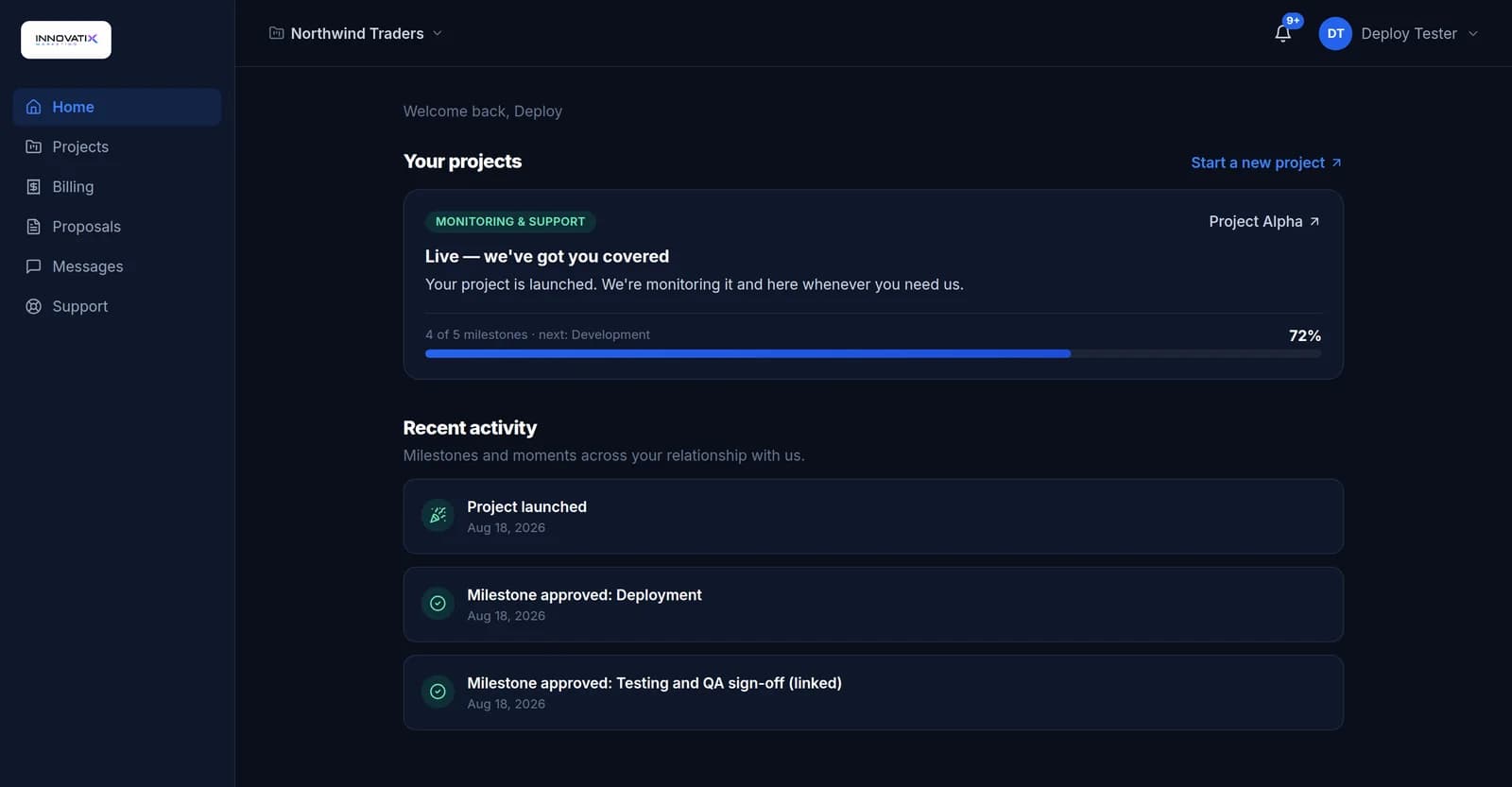
Track progress, review changes, and stay aligned through your project portal — projects, milestone progress, published updates, approvals, billing, and messages in one place.
 Client portal · demo
Common questions
- Is Kubernetes required?
- Only when it is justified. Many workloads run better and cheaper on simpler managed services. We recommend Kubernetes when the scale, portability, or orchestration needs genuinely call for it — not by default.
- Are cloud costs included?
- No. Hosting and cloud provider charges are billed by the provider on your own account and are scoped separately from our fees. We give an indicative cost estimate during design so there are no surprises.
- Can you guarantee zero downtime?
- No one can honestly promise that. We design for the availability level you need, test recovery, and set realistic targets — but we do not guarantee uptime or that incidents will never occur.
- Do you use our own cloud accounts?
- Yes, by default we work within your own provider accounts using delegated access at the permission level the work requires, so you retain ownership and control of the environment and its billing.
- Your existing environment and hosting setup
- Availability and performance needs
- How you release changes today
- Recovery requirements (backup and restore expectations)
- Approximate hosting budget
Tell us what you want to run more reliably.
Let’s talk about your environment, release process, and recovery needs — and the right infrastructure to support them.