
Data Warehouse Development
We design and build analytics warehouses structured for your reporting, with defined models and clear refresh schedules.
- Dimensional models for analytical queries
- Incremental loads on defined schedules
- Historical snapshots for trend analysis
Problems we solve
Analytics compete with production for resources
Running heavy reports against the app database slows down the very operations you are trying to measure. A warehouse isolates analytical workloads.
No conformed definitions
What is an "active customer"? A "shipped order"? Without conformed dimensions and documented definitions, every team computes metrics differently.
History is lost
Operational systems overwrite state. Without a warehouse capturing change over time, you cannot analyze trends, cohorts, or point-in-time snapshots.
The workflow
You provide
- Reporting requirements
- Source data feeds
- Governance expectations
We handle
- Warehouse schema design
- Load and transform jobs
- Access and security setup
You receive
- A structured data warehouse
- Query-ready data models
- Schema documentation
How we approach it
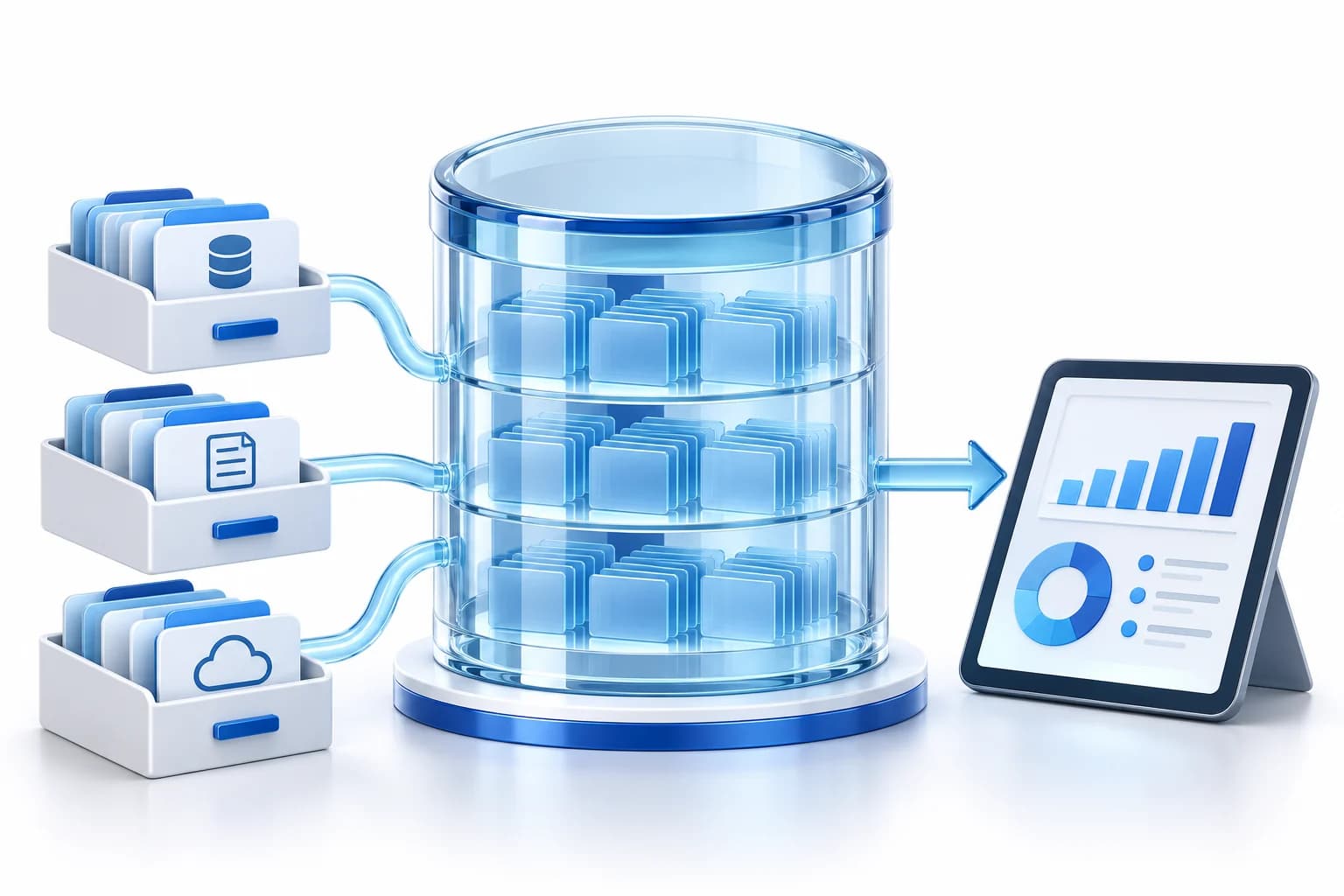
A data warehouse is the central store where data from every system is unified, modeled, and made ready for analysis. Done well, it ends the daily argument about whose numbers are right and lets anyone answer a question without touching production systems.
We design the schema around how your business actually operates, load it reliably, and govern access — so reporting, dashboards, and AI all read from the same trustworthy foundation.
A schema modeled on your business
We design conformed dimensions and fact tables (orders, customers, inventory, finance) so metrics are defined once and reused everywhere.
Reliable loads and history capture
Scheduled, monitored loads populate the warehouse and capture change over time, enabling trend, cohort, and point-in-time analysis.
Governed and documented
Role-based access, a data dictionary, and clear ownership make the warehouse safe to open up for self-service without losing control.
What you get
- A dimensional data model (facts, conformed dimensions) documented
- A provisioned, governed warehouse with role-based access
- Scheduled, monitored loads with history capture
- Conformed metric definitions and a data dictionary
- Query performance tuning and cost controls
- Documentation, handover, and support options
Technologies & integrations
Our delivery process
- 01Discovery
Define the metrics and questions, then design conformed dimensions and facts.
- 02Provision
Stand up the warehouse with governance and access controls.
- 03Load
Build monitored loads and capture change history.
- 04Model & tune
Build marts, conform metrics, and tune query performance.
- 05Enable
Document, grant access, and connect BI tools.
Amazon Sellers — unified reporting across channels
Frequently asked questions
Data warehouse vs. data lake — which do we need?
Most operations businesses need a modeled warehouse first: structured, query-ready tables with conformed metrics. A lake adds value later for large, semi-structured, or ML workloads. We help you choose based on your questions, not the trend.
Which warehouse technology do you use?
We match the tool to your scale and budget — PostgreSQL for moderate volumes, a columnar/MPP warehouse for large ones — and design the model so you are not locked in.
How do you control cost?
Through sensible partitioning, incremental loads, and query tuning, plus monitoring so runaway analytical queries do not surprise you on the bill.