
API Integration & Ecommerce Automation
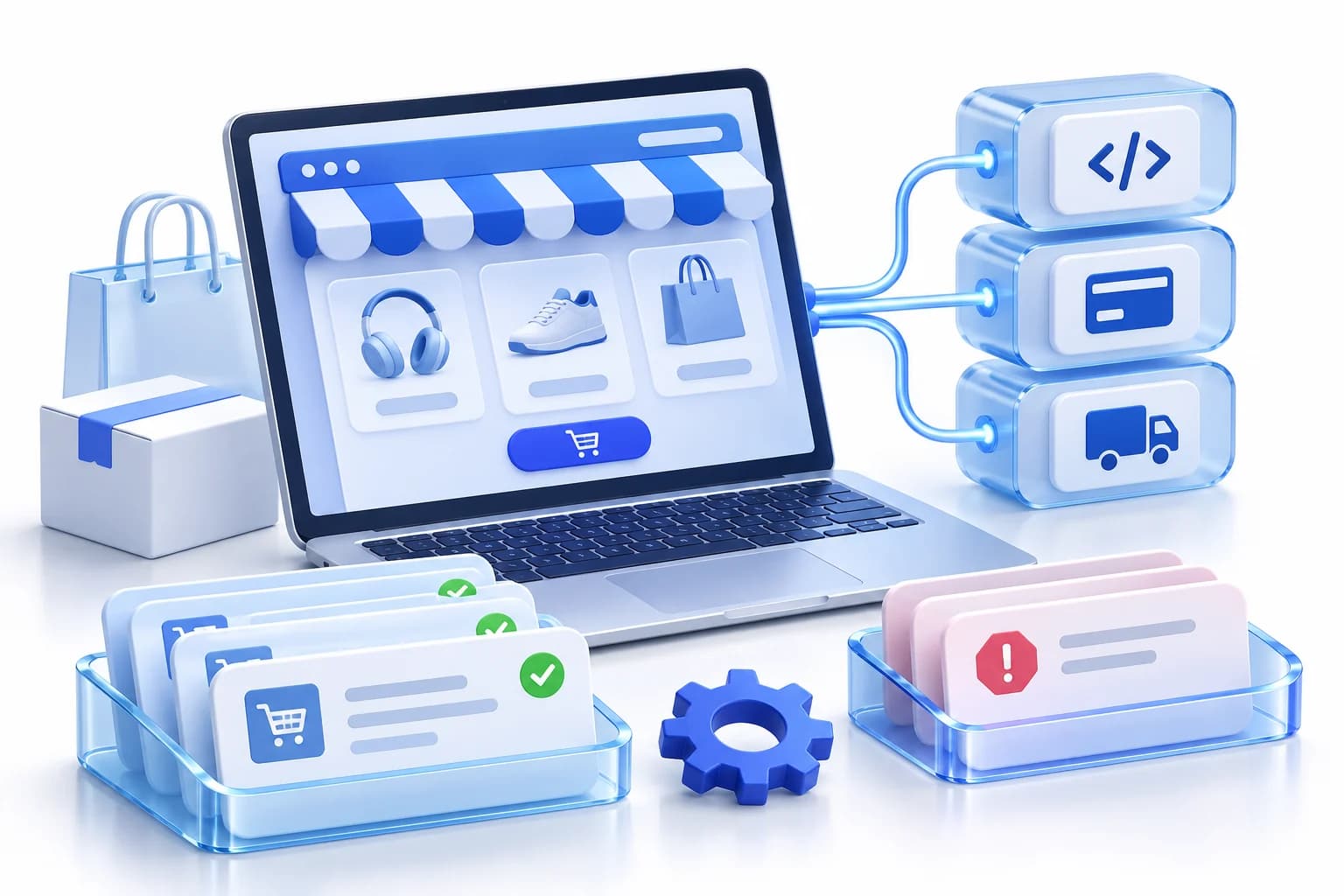
We build integrations against marketplace and carrier APIs to automate the manual steps in your ecommerce operation.
- Integrate SP-API, Walmart, and carrier endpoints
- Automate feeds, polling, and error retries
- Add logging and alerts for failed calls
Problems we solve
Systems don’t talk
Orders, inventory, and finance live in separate tools. We connect them with APIs and sync so the data stays consistent.
Manual re-keying
Copying data between systems wastes time and introduces errors. We automate the sync with clear rules.
Flaky, untrusted sync
Without idempotency, retries, and reconciliation, integrations drift. We build so you can trust the numbers.
The workflow
You provide
- System access & API keys
- Workflow & data details
- Test environment
We handle
- Integration, testing & error handling
- Automation build & checks
- Monitoring & retries
You receive
- Connected automated workflow
- Error log & review notes
- Setup & handover record
How we approach it
Build custom APIs, webhooks, scheduled feeds, and synchronization between marketplaces, stores, suppliers, carriers, payment systems, accounting tools, and your internal applications — so data moves reliably instead of by hand.
We define the system of record for each field, the synchronization direction, frequency, and conflict rules up front, then build with the reliability patterns production integrations need.
Designed sync model
System of record per field, sync direction and frequency, and explicit conflict rules — decided before code.
Built for production
Field mapping, authentication/token handling, pagination, webhook validation, retries and idempotency where appropriate, and error monitoring.
Verifiable
Reconciliation, technical documentation, and handover so the integration is operable and auditable. Production access is subject to your authorization and platform requirements.
What you get
- Field mapping and sync design
- Custom APIs, webhooks, and scheduled feeds
- Authentication and token handling
- Retries, idempotency, and webhook validation
- Error monitoring and reconciliation
- Technical documentation and handover
Technologies & integrations
Our delivery process
- 01Discover
Map systems, fields, and the system of record.
- 02Design
Define sync direction, frequency, and conflict rules.
- 03Build
Implement connectors, auth, and validation.
- 04Harden
Add retries, idempotency, monitoring, reconciliation.
- 05Handover
Document, test, and hand over to operations.
Connected data model across orders, inventory, and finance
Frequently asked questions
How do you stop data from getting out of sync?
We define a single system of record per field and build with idempotency, retries, and reconciliation, so conflicting writes are handled by rule rather than by luck.
Can you integrate systems you didn’t build?
Yes — connecting marketplaces, stores, suppliers, carriers, payments, and accounting tools to your internal apps is the core of this service.
Who authorizes production access?
You do. Production credentials and platform approvals are the customer’s to grant, subject to each platform’s requirements.