
Improve the workflow before adding tools.
We look at how work actually flows today — the manual steps, handoffs, and disconnected systems — and change the process first, so any new tools fit the way you work.
For businesses changing manual processes or planning modernization.

When this service helps
Manual steps and handoffs
Requests arrive by email, get re-keyed into spreadsheets, and pass between people by hand — slow, hard to track, and easy to get wrong.
Disconnected systems
Tools and data live in separate places, so the same information is entered more than once and nobody has a single, reliable view.
Growth is hard to support
The current process copes at today’s volume but strains as you add staff, customers, or channels — more work rather than more capacity.
What we can help with
Business Process Automation
Replace repetitive manual steps and handoffs with structured, reviewable workflows.
Digital Strategy
Agree where modernization is worth it, and where today’s process is good enough.
Technology Roadmaps
A sequenced plan of changes, dependencies, and decision points over time.
Architecture Assessments
Review current systems and data flows to see what to keep, connect, or replace.
Before and after a workflow change
A specific, illustrative example of changing one process — from manual and disconnected to connected, while keeping a human path for exceptions.
Before: an email request is re-keyed into a spreadsheet, reconciled by hand, and turned into a delayed report. After: a structured request becomes a validated record, routing is automated, anything that does not fit goes to an exception review handled by a person, and a live status is available throughout. Automation does not remove every exception or guarantee savings — the exception step stays in the “after” workflow.
You provide
- Your current manual process
- The outcomes you want
- People to involve and sign off
We handle
- Mapping the before and after
- Designing the structured workflow
- Rollout with exceptions kept in view
You receive
- A documented, structured workflow
- Fewer manual steps
- A plan for the remaining exceptions
How we work
- 1
Assess
Map how work flows today with the people who do it — steps, handoffs, systems, and where it breaks.
- 2
Prioritize
Rank candidate changes by value, effort, risk, and dependencies, and agree the order together.
- 3
Pilot
Change one workflow first, with agreed success measures, and review the result with your team before going wider.
- 4
Roll out & measure
Extend what worked to the next areas, document the new process, and track the agreed measures.
What you receive
Current-state assessment
A written picture of how work flows today, with the bottlenecks and disconnected steps identified.
Prioritized roadmap & dependencies
A sequenced plan of changes ranked by value, effort, and risk, with the dependencies between them made explicit.
Pilot plan & agreed success measures
A scoped first change with the measures we’ll use to judge it and the review points along the way.
People responsible for delivery
Illustrative delivery roles for this service — not named staff or promised staffing. Your team is defined in the proposal.
Owns the overall approach, prioritization, and the review points with your stakeholders.
Maps the current workflow, documents the target process, and defines the success measures.
Connects the systems and data involved so the changed workflow fits your existing tools.
Track progress, review changes, and stay aligned through your project portal — projects, milestone progress, published updates, approvals, billing, and messages in one place.
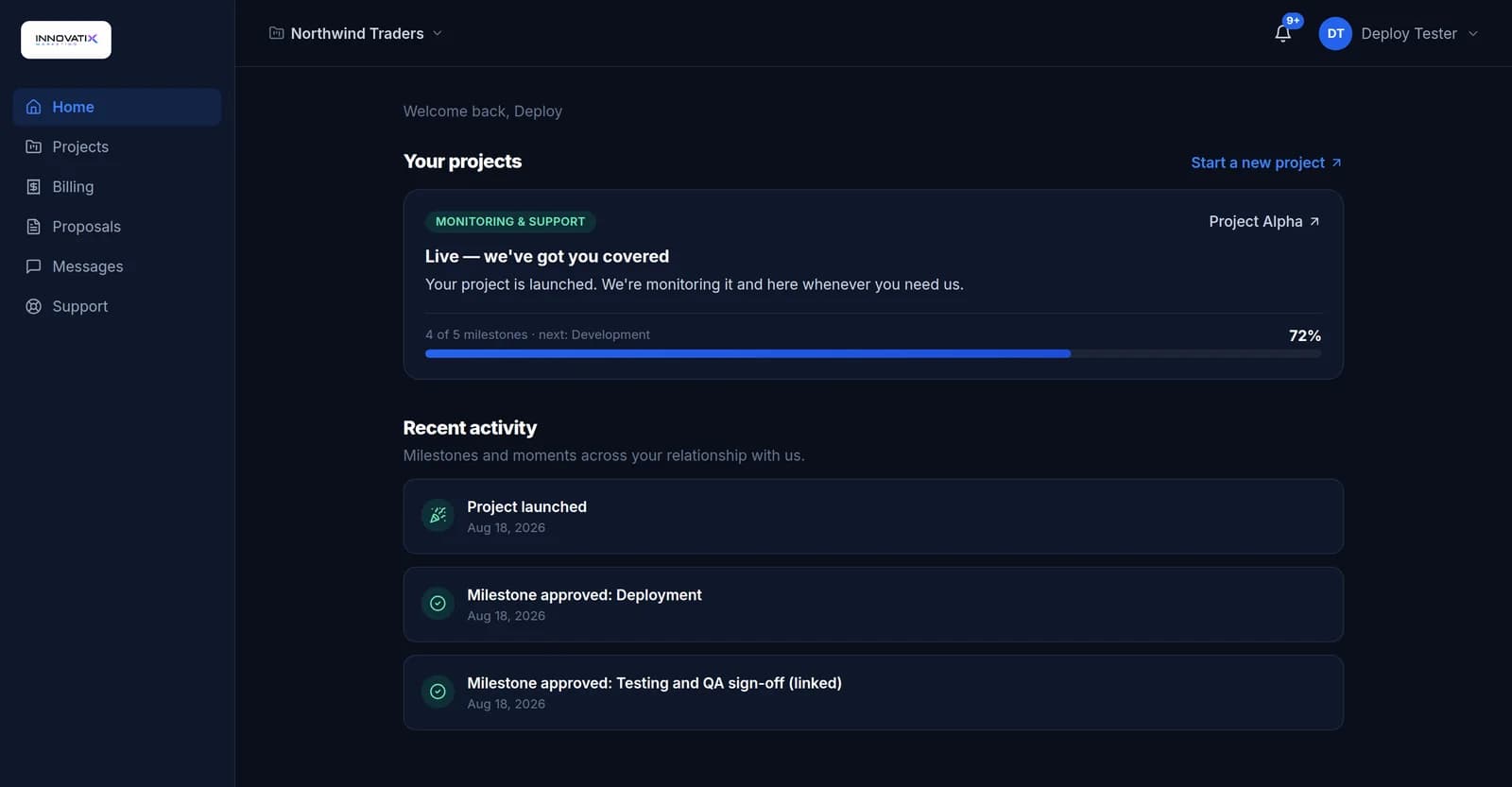 Client portal · demo
Common questions
- Do we need a full rebuild?
- Not necessarily. We assess first. Often the biggest gains come from changing the process and connecting existing systems rather than replacing everything — we only recommend a rebuild where the current foundation genuinely gets in the way.
- How do you decide what to do first?
- We rank candidate changes by value, effort, risk, and dependencies, and agree the order with you. Low-risk changes that unblock others usually come first; bigger bets are sequenced behind the pilots that de-risk them.
- Will automation replace our team?
- No. The goal is to remove repetitive steps so people spend time on the work that needs judgement. Exceptions still go to a person — we keep an explicit review path rather than letting edge cases pass through unchecked.
- Your current workflow and how work moves through it today
- The bottlenecks or manual steps you most want to remove
- Stakeholders and who owns each part of the process
- Constraints — systems, budget, timing, and compliance
- The measurable outcomes you want and the dependencies involved
Tell us about the process you want to improve.
Share one workflow that slows your team down, and we’ll assess it before recommending any tools.